Cleopatra's Pool and the terraces
Cleopatra's Pool: tickets, rules, gates
Swimming in Cleopatra's Pool takes its own ticket on top of Pamukkale entry. Here are the gates, hours and barefoot rules, checked against official pages.
Check dates and availability ↗Quick answer
Cleopatra's Pool, officially the Antique Pool, is a warm spring-fed pool inside the Hierapolis-Pamukkale site, with fallen marble columns on its floor. You need two things to swim there: a site ticket to get through the gates, and a separate pool ticket. The Ministry's MuseumPass The Mediterranean doesn't cover the swim. On 11 October 2026 the site was open daily, 08:00 to 18:00, and the ticket office closed at 17:00. The travertine terraces are walked barefoot.
Which ticket covers what
| Ticket | What it covers | The pool swim |
|---|---|---|
| Site ticket | Gates, terraces, ruins | Not included |
| Audio-guide ticket | Site entry, app guide | Not listed |
| MuseumPass Mediterranean | Ministry sites, 7 days | Not valid |
| Antique Pool ticket | Swimming in the pool | Included |
What Cleopatra's Pool actually is
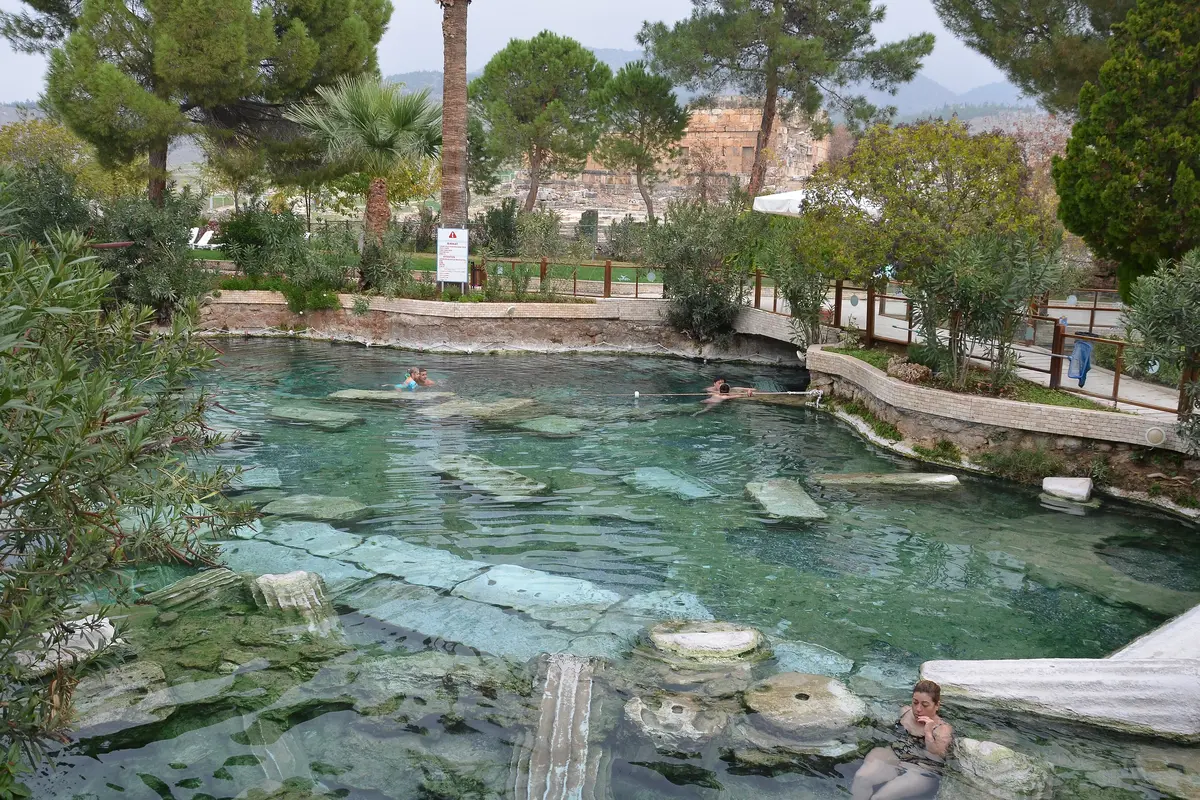
The Ministry of Culture and Tourism lists it simply as the antique pool, one of the sights of the Hierapolis-Pamukkale site. It sits inside the ancient city on the plateau above the white terraces, not on the terraces themselves. The marble on the bottom is real: a portico with Ionic columns fell into the spring in an earthquake in the 7th century AD, which shaped the pool you see today. UNESCO describes the area as a small lake formed by earthquakes and thermal sources around the ancient agora. Hotels were later built on the site and then removed, but the hot pool of one hotel was kept, and that is where you can swim for a fee.
Read next: How Pamukkale Was Saved From Its Own Hotels
Did Cleopatra ever swim here?
Nothing in the official record says so. The Ministry's description of Hierapolis covers its founding by Eumenes II, king of Pergamon, in the 2nd century BC, its rebuilding after the great earthquake of AD 60, and St Philip's martyrdom in AD 80. Cleopatra isn't mentioned, and the pool appears in official pages as the antique or ancient pool. Treat the name as a nickname. What is documented is the bathing culture around it: UNESCO calls Hierapolis an exceptional example of a Greco-Roman thermal installation, with immense hot basins and pools for swimming. The draw today is the same water and the fallen marble, not a royal visitor.
Two tickets: the site and the swim
Getting into the pool takes two separate purchases. First comes a site ticket, which gets you through the gates and onto the terraces and the ruins of Hierapolis. Then, if you want to swim, you buy a pool ticket as well. The Ministry's page for MuseumPass The Mediterranean, which includes its sites in Denizli province, says plainly that it isn't valid at the Hierapolis Ancient Pool and that you must buy a separate ticket. MuseumPass The Aegean also covers Denizli sites; its page doesn't mention the pool, so don't count on it for the swim either. With either pass, you can enter each site once.
- Site ticket: gates, travertines and the ruins of Hierapolis
- Pool ticket: needed on top, for swimming only
- MuseumPass cards: valid for 7 days from your first visit, one entry per site
- The Archaeology Museum has its own ticket office and hours: 08:00 to 17:30
The three ways in
The site has three entrances, and the one you pick shapes your day. The Ministry names them as the South Gate, the North Gate and the pedestrian entrance. The South and North Gates are up on the plateau, where UNESCO notes visitor centres were built. The pedestrian entrance is at the foot of the hill, by Pamukkale village, so from there you climb the terraces barefoot before you reach the ruins and the pool. Private cars aren't allowed inside the site except in emergencies, and public transport is provided for visitors. On 11 October 2026 the Ministry gave the South and North Gates a closing time of 18:00, and the pedestrian entrance 17:00.
- South Gate: on the plateau, closes 18:00
- North Gate: on the plateau, passing the necropolis, closes 18:00
- Pedestrian entrance: at the foot of the terraces, closes 17:00
Opening hours
When we checked on 11 October 2026, the Ministry listed the site as open every day from 08:00 to 18:00, with the ticket office closing at 17:00, and the Antique Pool open to visitors. Lonely Planet notes that from mid-October to March the last tickets are sold at 17:00, so hours shift with the season. Plan to be inside by mid-afternoon in winter. A swim, the terraces and the theatre all take time, and the pedestrian entrance shuts an hour before the upper gates. Check the Ministry's page for the current times before you travel, especially for an early start or a late visit.
On the travertines: shoes off
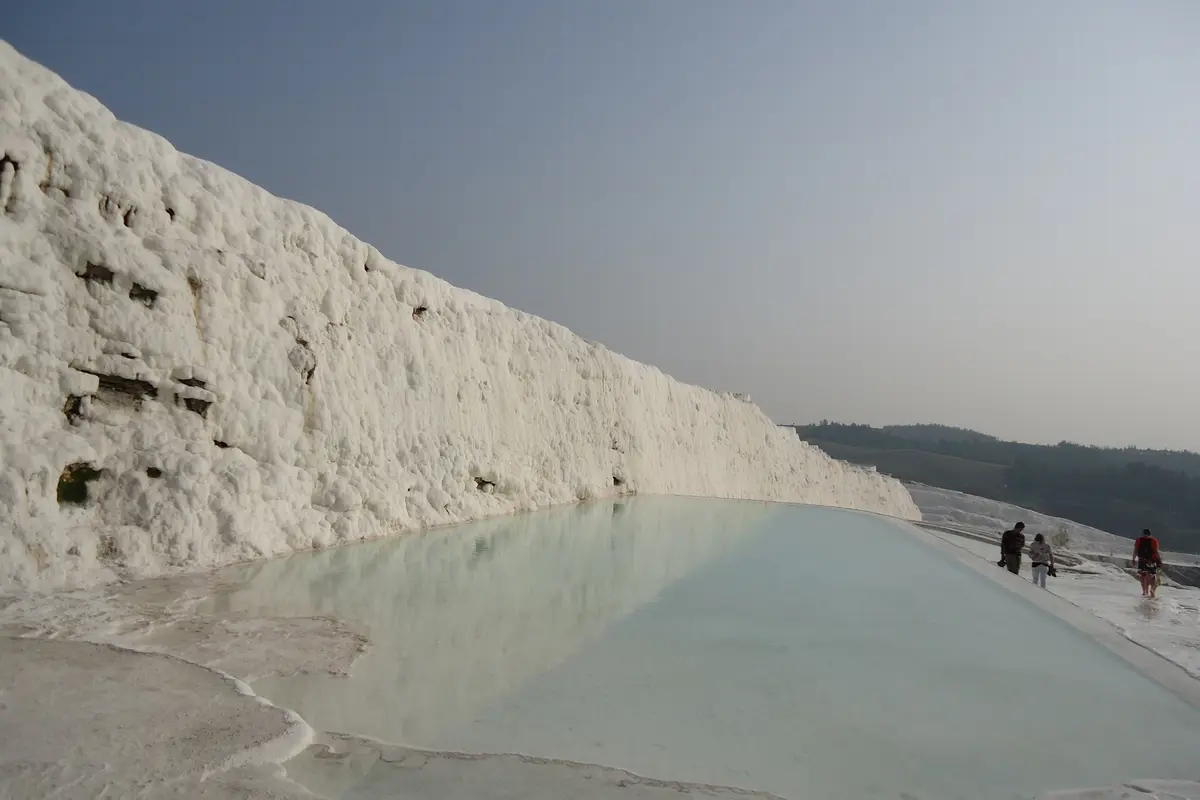
To protect the calcite surface, guards make you take your shoes off on the travertines, so carry them in a bag. The ground looks rough but the constant water flow keeps it mostly smooth, even gooey in places, and slipping is a bigger risk than cutting your feet. Walking straight down the terrace path to the village takes about 30 minutes, and the steady downhill is hard on the knees. How many calf-deep pools you wade through depends on the time of year. If you plan to swim in the Antique Pool, you'll be carrying swimwear and a towel as well, so travel light.
Read next: How Pamukkale's White Terraces Actually Form
Why some terraces are dry or closed
The empty basins aren't a fault. UNESCO says visitor access to the travertine terraces is prohibited in order to sustain the water flow and keep their colour and structure, and that set areas where visitors can bathe in the hot springs have been established. The authorities regulate the water and periodically close sections so the formations can regenerate. In practice you walk a marked route, and the water-filled pools along it change from season to season. Photos of every basin brimming may not match your day. Midday to 4pm brings crowds and harsh light reflecting off the white surface; early morning or sunset is better.
Terrace pools or the Antique Pool?
They're different things. The terrace pools along the path are shallow, mostly up to calf height, and are part of your site ticket. There's also a channel of warm water at the top of the path where people sit and soak their legs. The Antique Pool is a proper swim among submerged marble, with its own ticket. UNESCO flags one real concern: thousands of tourists swim between the columns, which has led to biological pollution and constant erosion of the Roman marble, and the authorities plan a monitoring system. If you swim, you're part of that, so treat the stones gently and don't climb on them.
The audio-guide ticket we link to
The ticket we link to is a self-guided entry run by Katalay, not a guided tour or a day trip. It includes a skip-the-line ticket for Pamukkale and Hierapolis, with fast-track entry through a separate entrance, and access to the ancient city, the museum, the theatre, the Roman bath, the Plutonium and the Martyrium of St Philip. The audio guide plays on your own smartphone and works offline. Allow about 3 hours. Your QR-code ticket arrives by email. Cancellation is free up to 24 hours before, and you can reserve now and pay later. The Antique Pool swim isn't part of it.
- Included: skip-the-line site ticket and smartphone audio guide with offline access
- Not included: headphones, food and drink, transport
- Bring: comfortable shoes, comfortable clothes and a change of clothes
Who this isn't for
Skip the audio-guide ticket if you need transport from the coast: it has none, so you have to reach Pamukkale yourself. If you want a person explaining the ruins and answering questions, an app won't do that, and you'll need your own phone and headphones. If you already hold a MuseumPass that covers Denizli, check whether you need a site ticket at all; you'll still pay for the pool. If the swim is the whole point, remember it's an extra ticket on top of any of these. And if anyone in your group finds a barefoot, slippery downhill walk hard, enter at an upper gate and leave the terraces out.
Frequently asked questions
Is Cleopatra's Pool included in the Pamukkale ticket?
No. The site ticket gets you through the gates to the terraces and the ruins of Hierapolis, but swimming in the Antique Pool needs its own ticket. The audio-guide ticket we link to doesn't include the swim either.
Does the Museum Pass cover Cleopatra's Pool?
No. The Ministry's page for MuseumPass The Mediterranean says it isn't valid at the Hierapolis Ancient Pool and that you must buy a separate ticket. MuseumPass The Aegean also covers Denizli sites, but its page doesn't mention the pool, so plan to pay for the swim.
Do you have to take your shoes off at Pamukkale?
Yes, on the travertines. Guards make you go barefoot to protect the calcite surface, so carry your shoes in a bag. The surface is mostly smooth and can be slippery, and the walk down to the village takes about 30 minutes.
Can you swim in the Pamukkale terraces?
Not really. The terrace pools on the marked path are shallow, mostly up to calf height, and good for paddling. Sections are closed in rotation to protect the formation. For a real swim, go to the Antique Pool, which has its own ticket.
What time does Pamukkale close?
On 11 October 2026 the Ministry listed the site as open daily, 08:00 to 18:00. The South and North Gates close at 18:00, and the pedestrian entrance and the ticket office at 17:00. Hours change with the season, so check before you go.
Which gate is best for Cleopatra's Pool?
An upper gate, the South or North Gate, puts you on the plateau with the ruins and the pool, with no barefoot climb first. From the pedestrian entrance by the village, you walk up the terraces barefoot to reach them.
Sources
- Hierapolis Pamukkale Travertine Archaeological Site (Ministry of Culture and Tourism)
- MuseumPass The Mediterranean (Ministry of Culture and Tourism)
- MuseumPass The Aegean (Ministry of Culture and Tourism)
- Hierapolis Pamukkale Archaeological Museum (Ministry of Culture and Tourism)
- Hierapolis-Pamukkale (UNESCO World Heritage Centre)
- Travertines, Pamukkale (Lonely Planet)
- Hierapolis (Wikipedia)